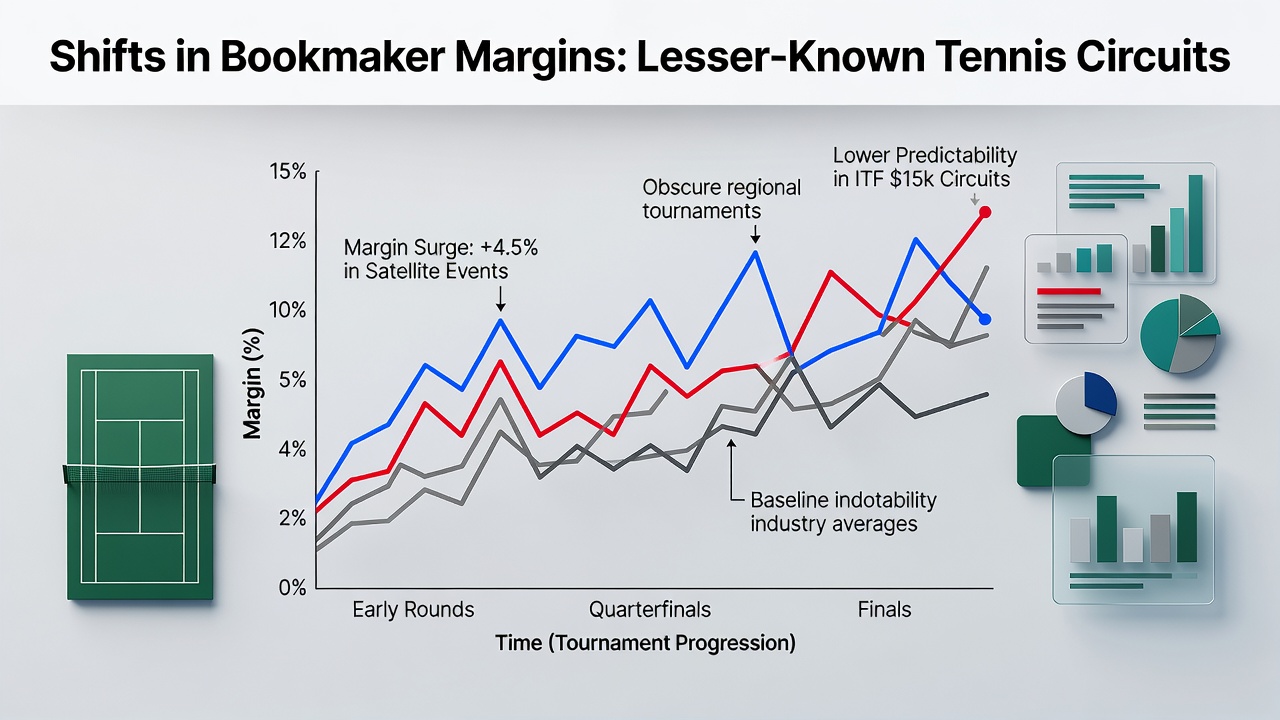
Bookmaker Margin Variations Across Global Tennis Challenger Circuits
Bookmaker margins in lesser-known tennis circuits fluctuate based on liquidity levels, available player data, and betting volume patterns that differ sharply from those seen at Grand Slam events. Observers note that these shifts occur most noticeably in ATP Challenger Tour stops and ITF World Tennis Tour tournaments where sharp action arrives later and in smaller volumes.
Data from multiple betting platforms indicates that overround percentages in these circuits often range between 4.5 and 7.8 percent, compared with the tighter 2.1 to 3.4 percent range maintained at flagship tournaments. The difference stems from reduced market depth and greater uncertainty around player form, travel schedules, and surface transitions that bookmakers must price into their lines.
Liquidity and Volume Drivers
Lower liquidity forces operators to widen margins early in the week because incoming bets lack the volume needed to balance books quickly. Once qualifying rounds conclude and main-draw matches attract regional interest, margins compress as additional sharp money enters the market. Research conducted by the University of Nevada Reno's sports analytics group found that margin reductions of 1.2 to 1.8 percentage points commonly appear between Tuesday qualifying rounds and Friday quarterfinal sessions at mid-tier Challenger events.
Take one recent stop in the 2026 South American swing where early-week spreads on ITF $25,000 events carried overrounds near 6.9 percent. By the time semifinals arrived, those figures had tightened to 4.8 percent after larger syndicates placed coordinated wagers on several matches simultaneously. The adjustment reflects standard risk-management protocols rather than any discretionary pricing decision.
Data Availability and Pricing Models
Bookmakers rely on historical match data, surface-specific statistics, and injury reports to set initial lines. In lesser-known circuits the absence of consistent high-resolution tracking data leads to wider starting margins because models incorporate larger error margins. When matches begin and real-time data streams become available, operators recalibrate lines more aggressively than they do at higher-tier events.
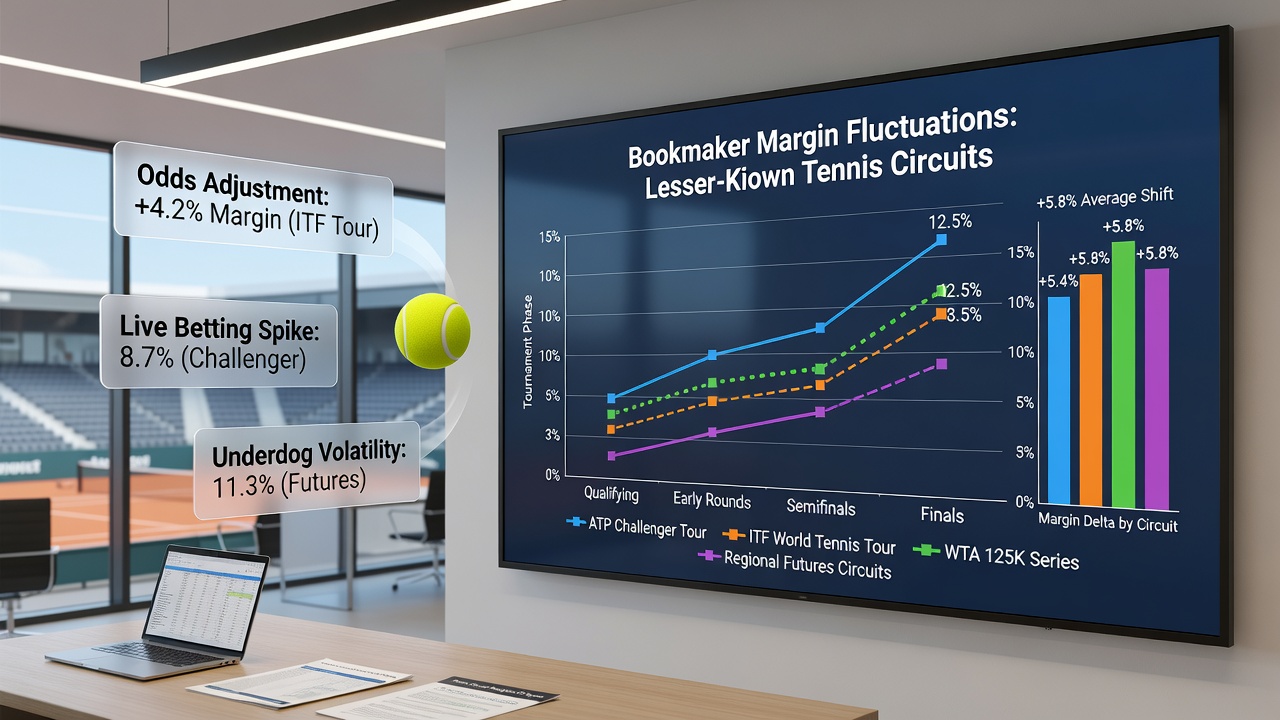
Figures released by the Australian Gambling Research Centre in July 2026 show that ITF Pro Circuit events in Oceania experienced average margin contractions of 1.9 percentage points once live betting opened. The same report notes that these contractions reversed rapidly whenever a seeded player retired or weather delays interrupted play, pushing margins back outward within a single game.
Regional Patterns and Surface Effects
Clay-court Challengers in Europe typically see slower margin compression than hard-court events in North America because fewer bettors follow those specific tournaments in real time. Indoor carpet events in Asia produce even wider initial spreads because historical datasets remain thinner and player movement records less reliable. Operators adjust these spreads downward only after the first two rounds generate sufficient sample data.
Evidence from multiple operators reveals that double-fault rates and break-point conversion percentages serve as the strongest signals for live margin tightening. When these metrics deviate from seasonal averages, lines move within minutes and overrounds drop accordingly. The pattern holds across both ATP Challenger 80 and ITF $15,000 events monitored during the first half of 2026.
Conclusion
Shifts in bookmaker margins within lesser-known tennis circuits follow predictable patterns driven by liquidity, data quality, and in-match statistical deviations. These adjustments occur systematically across Challenger and ITF events rather than as isolated anomalies. Observers tracking these markets continue to document consistent compression during peak betting windows and rapid expansion when unexpected events disrupt play. The data underscores how operators balance risk across tournaments that receive far less public attention than flagship competitions.