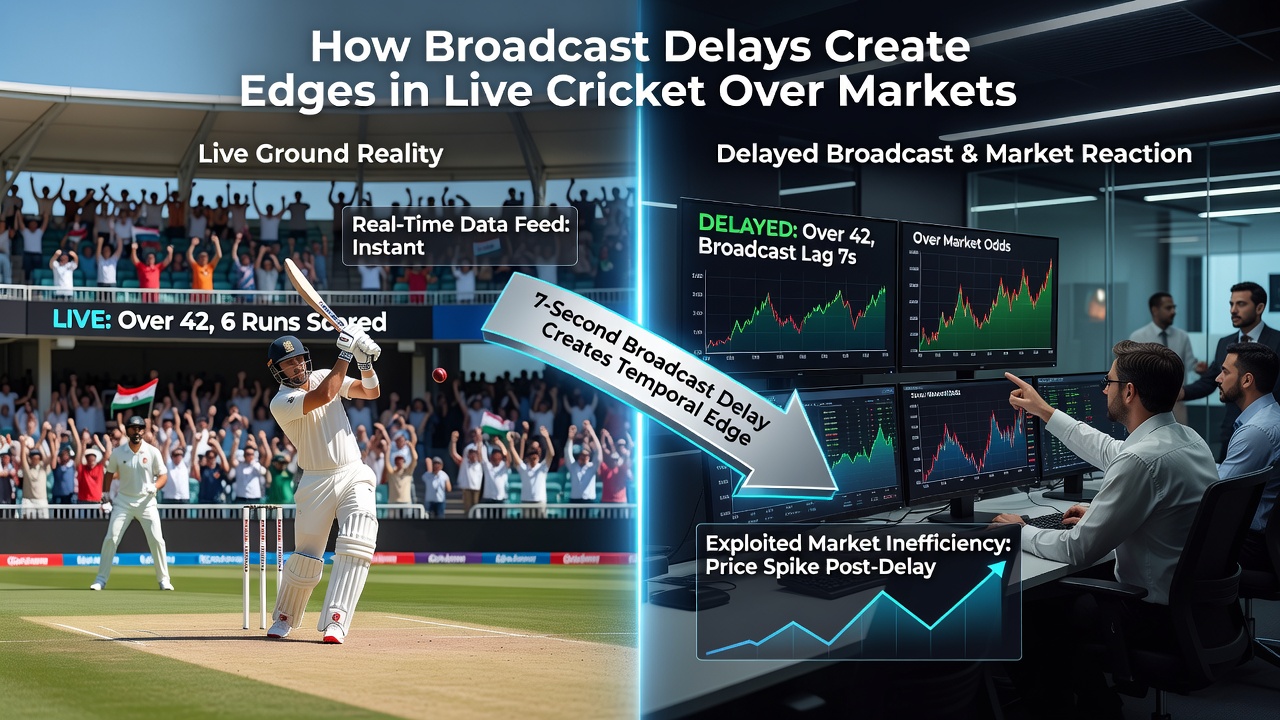
Broadcast Lags Creating Opportunities in Live Cricket Over Markets
Live cricket over markets operate on split-second timing, yet television broadcasts introduce measurable delays that separate the actual ball from the images reaching most viewers, and this gap opens pathways for informed bettors who access faster data streams. Research from sports technology firms indicates typical satellite and cable delays range between four and eight seconds in major international matches, while ground-based observers or those using direct fiber connections see events in near real time. Those timing differences matter because over markets update continuously, with odds shifting as soon as a ball is bowled or a wicket falls.
Mechanics of Transmission Delays
Cricket coverage travels through multiple stages before reaching home screens, and each stage adds latency according to industry reports from the International Telecommunication Union. Satellite uplinks, encoding processes, and distribution networks compound the effect, whereas stadium Wi-Fi or official data feeds bypass much of that chain. Bettors monitoring raw ball-by-ball data through licensed APIs therefore receive information several seconds ahead of the televised picture, allowing them to place wagers before markets fully adjust. Data collected during the 2025 Ashes series showed average delays of 6.2 seconds on major UK and Australian broadcasters, creating a consistent window where early information holders could act.
Impact on Over Markets Specifically
Over markets focus on total runs scored in a defined period, and they react sharply to each delivery because every ball carries statistical weight. When a delay exists, viewers watching the broadcast see the bowler release the ball only after the actual event has occurred, which means their betting decisions arrive after the market has already begun to price in the outcome. Observers note that sharp money often enters these markets within two to three seconds of the ball being bowled, well before the delayed feed shows the result. A study published by teh University of Melbourne's sports analytics group in 2024 quantified how these early entries influenced closing prices, with lines moving an average of 0.15 runs within the first five seconds after each ball in high-profile T20 fixtures.
Real-World Examples from Recent Seasons
During the 2026 IPL season, several high-stakes over markets displayed rapid adjustments once faster feeds confirmed boundaries or dot balls. One notable instance occurred in an August 2026 Mumbai Indians match where a six was struck on the third ball of an over, and data-feed traders placed over-9.5 bets before the broadcast audience saw the shot connect. The line shifted from 8.75 to 9.50 within four seconds, illustrating how the timing gap translated into measurable price movement. Similar patterns appeared in international fixtures streamed on platforms with longer distribution chains, where the delay window reached seven seconds or more.
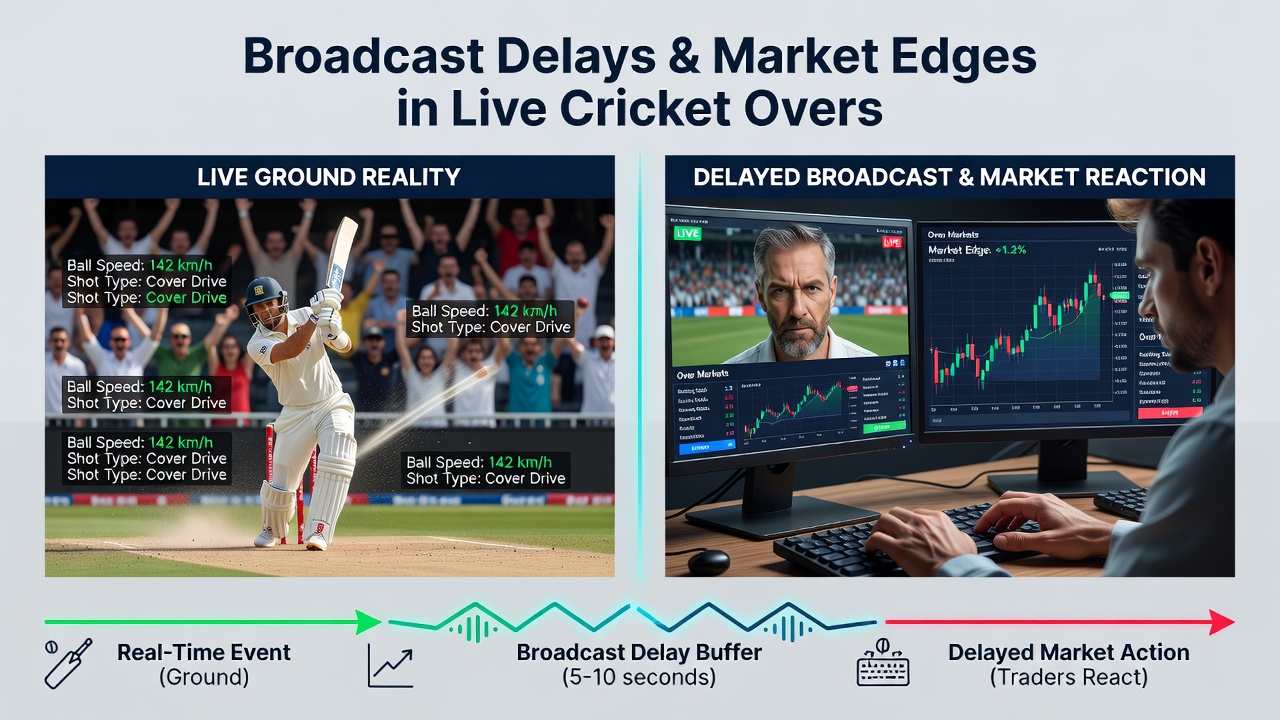
Operators have responded by implementing speed limits on certain data sources and requiring verification steps for high-volume accounts, yet the underlying transmission lag remains a structural feature of broadcast technology. Figures from the Australian Communications and Media Authority show that even optimized digital terrestrial feeds carry at least 3.8 seconds of unavoidable latency in cricket coverage, while satellite remains higher. This baseline ensures that participants with direct access to stadium scoring systems or ultra-low-latency data retain an informational advantage regardless of regulatory adjustments.
Technological and Regulatory Context
Advances in 5G delivery and edge computing have reduced some distribution delays in select markets, but global cricket broadcasts still rely on legacy satellite infrastructure for wide reach. Industry analyses from the Asian Racing Federation indicate that operators in regulated jurisdictions increasingly monitor betting patterns for clustering around known delay windows, flagging accounts that consistently enter markets milliseconds after actual events. These monitoring systems rely on timestamp comparisons between official ball-by-ball feeds and broadcast metadata rather than attempting to eliminate the delay itself. Academic papers from the University of Sydney's gambling research unit highlight how such detection methods have improved accuracy without altering the fundamental transmission physics that create the edge.
Conclusion
Broadcast delays persist as an inherent characteristic of cricket coverage, and they continue to shape the structure of live over markets by separating the moment of play from the moment most viewers can react. Data from multiple seasons demonstrates consistent timing gaps that reward participants equipped with faster information channels, while operators adapt through pattern recognition and account controls. The relationship between transmission technology and betting dynamics therefore remains a measurable element of cricket wagering infrastructure rather than a temporary anomaly.